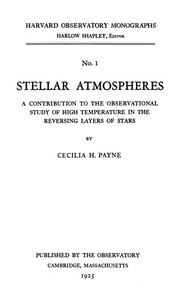
Stellar atmospheres : A contribution to the observational study of high…
Let's set the scene: it's the 1920s. Astronomy is dominated by men who are sure they have the basics figured out. They look at the light from stars through their spectroscopes and match the patterns to elements they know from Earth. The conclusion? Stars must be similar to our planet. Enter Cecilia Payne, a 25-year-old graduate student at Harvard. Using cutting-edge physics and mountains of observational data, she does her own analysis. Her calculations point to a shocking result: hydrogen is millions of times more abundant in stars than on Earth, with helium a close second. The common elements of Earth are actually cosmic trace elements.
The Story
This isn't a novel with characters in the traditional sense. The 'plot' is the journey of a scientific idea. Payne meticulously presents her evidence, building a rock-solid case that the composition of the universe is nothing like what everyone assumed. The central conflict isn't with a villain, but with a deeply held belief. The most dramatic moment comes when a leading authority, Henry Norris Russell, pressures her to downplay her revolutionary finding in her published thesis. She reluctantly adds a line suggesting her result is 'almost certainly not real.' History, of course, proved her utterly right. Within a few years, even Russell conceded she had discovered the fundamental truth of cosmic chemistry.
Why You Should Read It
You should read this because it's a masterclass in quiet courage. Payne's writing is clear, precise, and forceful even today. Reading the original work, you feel the weight of her evidence and the quiet confidence behind it, even as she was told to soften her conclusions. It’s the moment a young woman looked at the data, trusted her work over the word of famous men, and rewrote the textbook. It’s also surprisingly accessible in its core ideas. You don't need a PhD to grasp the monumental shift she described: we are not made of the same stuff as the stars; the stars made the stuff that eventually became us.
Final Verdict
This is for anyone fascinated by history, science, or stories of overlooked genius. It's perfect for readers who love a real-life 'Eureka!' moment, for fans of hidden figures in history, and for anyone who needs a reminder that groundbreaking truth often comes from unexpected places. It's a short, dense scientific paper, so it requires a bit of focus, but the payoff is understanding the exact moment we first truly understood what the universe is made of. More than that, it’s a powerful reminder to always question the established story, even—or especially—when it's told by experts.
This masterpiece is free from copyright limitations. Preserving history for future generations.