
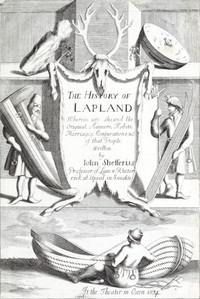
The History of Lapland by Johannes Scheffer
Published in 1673, Johannes Scheffer's The History of Lapland isn't a history book in the way we think of one today. Scheffer was a Swedish-born scholar living in Uppsala, and he compiled this work without ever visiting the region himself. He pieced it together from older texts, traveler's tales, and reports from missionaries.
The Story
There isn't a plot in the novel sense. Instead, Scheffer builds a systematic portrait of a land and its people, the Sami. He describes the harsh Arctic environment, the wildlife (especially the crucial reindeer), and Sami customs, religion, and daily life. He dedicates significant space to their shamanic practices, detailing the rituals of the noaidi (shamans) and their use of a sacred drum. The book presents a mix of keen observation (likely from his sources) and pure folklore, blending reality with myths about magic and strange creatures. For over a century, this was the book Europeans turned to understand the mysterious North.
Why You Should Read It
This book is fascinating not as an accurate ethnography, but as a mirror. It shows us how knowledge was made in an age before easy travel or fact-checking. You're not just reading about Lapland; you're reading about 17th-century European curiosity, fear, and imagination. When Scheffer describes a shaman's journey to the spirit world, you can feel the awe and suspicion in his writing. It's a reminder that 'non-fiction' has always been filtered through the writer's own world. The value here is in the gaps—seeing what he got right, what he exaggerated, and what he completely invented tells a story bigger than any single fact.
Final Verdict
This is a perfect pick for readers who love weird history, the history of ideas, or cultural studies. If you enjoyed Charles Mann's 1491 or any book that examines how perceptions are formed, you'll find a primitive ancestor here. It's not a quick or easy read—the prose is dense and old-fashioned—but it's incredibly rewarding if you're patient. Approach it not as truth, but as a captivating historical artifact that shaped Western views of the Arctic for generations. You'll come away thinking more about the storyteller than the story.
This publication is available for unrestricted use. You can copy, modify, and distribute it freely.
Joseph Anderson
2 years agoI decided to give this a try based on a colleague's recommendation, the quality of the diagrams and illustrations (if applicable) is top-notch. A rare gem in a sea of mediocre content.
Nancy Hernandez
2 months agoThe peer-reviewed feel of this content gives me great confidence.
Linda Wilson
11 months agoClear, concise, and incredibly informative.
Charles Wilson
2 years agoWhile browsing through various academic sources, the structural organization allows for quick referencing of key points. It definitely lives up to the reputation of the publisher.






Paul White
5 months agoThe citations provided are a goldmine for further academic study.