
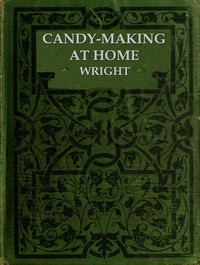
Candy-Making at Home by Mary M. Wright
Okay, let's be clear from the start: this is not a page-turner in the traditional sense. There's no villain (unless you count burnt sugar) and no plot twist (though a failed batch of fudge can feel like one). 'Candy-Making at Home' is exactly what it says on the tin: a practical guide published in 1911. Mary M. Wright, a principal of a domestic science school, lays out the principles and recipes for creating everything from simple molasses candy to elaborate opera creams and fruit lozenges at home.
The Story
The 'story' is the journey from raw sugar to finished confection. Wright structures it like a textbook, starting with the essential equipment (emphasizing the importance of a good copper kettle and a marble slab) and the core techniques like boiling syrup to specific temperatures. She then walks you through categories: fondants, creams, caramels, nougats, and glaced fruits. Each recipe is a concise paragraph, assuming you understand terms like 'soft ball' stage or how to 'work' the candy. It's a systematic, no-nonsense approach to what was considered a vital skill for a competent homemaker.
Why You Should Read It
Here's the thing: I love this book not because I've made every recipe (I haven't), but because of the window it opens. Reading Mary Wright is like listening to a very precise, patient expert from another era. You feel the pride in self-sufficiency. This was before candy was a cheap, ubiquitous commodity; making it was an event, a demonstration of care and skill. The recipes are historical artifacts. When she casually mentions using a 'chip' of chocolate or flavoring with rose water, you're getting a direct taste of 1911. It makes you appreciate the craft and chemistry that went into everyday treats. It also quietly celebrates the science of the home kitchen in a way we've mostly forgotten.
Final Verdict
This book is perfect for food history nerds, adventurous home bakers looking for a pre-modern challenge, and anyone with a soft spot for old manuals and primary sources. It's not for someone who wants foolproof, modern recipes with precise grams and thermometer readings. You'll need to read between the lines and be ready for some trial and error. Think of it less as an instruction manual and more as a conversation with a knowledgeable ancestor. If that sounds intriguing, you can find it for free on Project Gutenberg. Brew some tea, imagine the smell of cooking sugar, and spend an afternoon with Mary. You might not make perfect peanut brittle, but you'll gain a whole new respect for the candy in your cupboard.
This work has been identified as being free of known copyright restrictions. Enjoy reading and sharing without restrictions.
Jennifer Davis
11 months agoBefore I started my latest project, I read this and the emphasis on ethics and sustainability within the topic is commendable. I'm glad I chose this over the other alternatives.
Susan Martin
2 weeks agoThe author provides a very nuanced critique of current methodologies.
Barbara Thomas
8 months agoI was skeptical about the depth of this book at first, but the wealth of information provided exceeds the average market standard. A mandatory read for anyone in this industry.
Nancy Smith
1 year agoI have to admit, the narrative structure is incredibly compelling. Highly recommended.
Mary Taylor
3 months agoThis digital copy caught my eye due to its reputation, the narrative arc keeps the reader engaged while delivering factual content. I’ll definitely be revisiting some of these chapters again soon.